

In the Boston Globe article Confessions of a professional clickbait writer, Ben Kissam touches on some of the controversy surrounding the different approaches to driving traffic.
“I’m not paid to write beautiful prose; I’m paid to grab eyeballs.”
The article as a whole has a light, almost sarcastic tone. Kissam seems to both criticize the lack of quality and prevalent plagiarism in his career, and refuse to apologize for being wildly good at it.
“If you’ve Googled anything related to the ketogenic diet, preparing your student for college, medical billing for health care providers, cloud computing for small businesses, or how the industrial Internet of things affects farming — among a dozen other topics — there’s a solid chance you’ve read my work.”
This more relaxed approach to what a NiemanLab article by Caitlin Petre calls “traffic whoring” is interesting for two reasons: Kissam’s acceptance of his role doing the “dirty work,” and his distancing himself from the “SEO content farms” that fall below his standards. This reinforces Petre’s observation that journalists (and other web writers) have a tendency to create “symbolic boundaries” to delineate what is too far. As far as driving traffic goes.
Part of these boundaries are wrapped up in the editorial mission of the publication. Gawker, for instance, has a very different criteria for content than The New York Times or The Boston Globe.


Traffic metrics are undeniably important. Engagement is what these websites run on, quite literally, so drawing and keeping engagement is not just smart business, but also non-negotiable.
So where is the line?
Petre notes that:
“Similar symbolic boundaries between a product’s content and its form and mode of distribution have long existed in many cultural industries.”
However, web SEO and traffic metrics are new enough to the industry that the symbolic boundaries aren’t standardized yet. Kissam’s “SEO content farms” just want the eyeballs and the clicks, even if all the freelancers are doing is copy-pasting. JSTOR Daily writers on the other hand, care so much about the content that SEO optimization might fall completely to the wayside except for titles.
Personally, my steeped-in-academia little student heart wants to staunchly proclaim that JSTOR Daily has the right of it. However, realistically, that isn’t a business model that would work for a fast news website the way it works for JSTOR Daily’s slow news. And, it limits growth. JSTOR Daily will never be BuzzFeed. But that’s okay because they don’t want to be. And that’s where we get to the crux of it — want.
A publication’s editorial mission and business model will impact where their symbolic content mining and traffic driving boundaries fall. Whether or not the industry settles on an ethical standard. As such, any standard would need to be a range, a sliding scale.
It would have to look something like this:
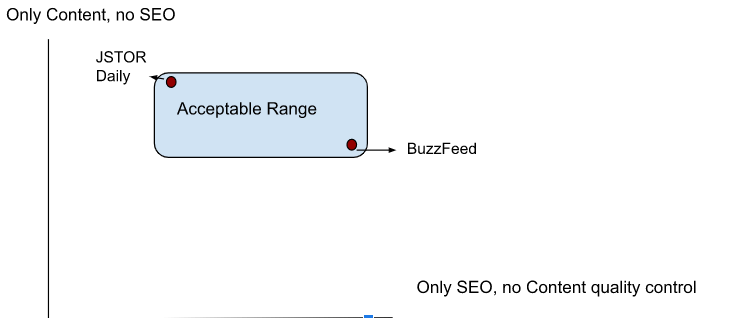
The problem is still where is that range? Every journalist, blogger, editor, or CEO might argue for a different set of parameters that determine what is so far to the bottom right as to be unethical, and what is so far to the top left as to be impractical. Some SEO is required.
“In 2019, my article was the number one search result for that query. That year, 35,339 people read it. In 2021, my article dropped to the bottom of page one, where it hovered between spots eight and 10. The page received only 8,470 views last year, a 76 percent decline.”
As Kissam notes, that kind of decline can pull companies under.
That brings us back to the question I asked earlier in this article, “So where is the line?” The answer — I don’t know.
What I do know is that for years a variety of schools have imprinted the idea that plagiarism is a heinous crime.
What I do know is that, like everyone else, I have a tendency to skim articles for keywords and eye-catching headlines.
What I do know is that I deeply appreciate JSTOR Daily for its reliable information, and adore BuzzFeed quizzes.
What I do know is that I would be incredibly frustrated and hurt to see my own writing copy-pasted to some other website.
What I do know is that there are only so many ways and times something can be said for repetition is inevitable, especially considering parameters such as it being couched in a certain way for a certain audience.
What I do know, is that this debate is far from over.


Leave a Reply