

Instead of the normal Tuesday Review, you lovely folks get to enjoy a class assignment examining online communities—kind of like what I’m trying to build here.
What makes a community? According to Merriam-Webster: “a unified body of individuals[.]” These individuals may gather because of common interests, geographic location, shared characteristics, and other such similarities. Are online communities any different?
What are online communities?
“[C]lusters of people who interact with each other in designated online spaces, sharing opinions, perspectives, thoughts, and information around a common topic or to achieve a shared goal.”
This quote is from an article by Casey Botticello for Blogging Guide.
One of the common confusions with online communities is social platforms like Facebook—Facebook itself is not a community, it is a social platform that people use to build communities like Facebook groups. The Princess Bride: Inconcievableposting, Non-Binary Gender Pride, and The Tolkien Society are a few of the ones I have joined.
Reddit is also not a community, but many of its millions of subreddits are, such as the famous Am I the Asshole? or Petty Revenge. However, you don’t need to use the tool of social platforms to build an online community, you can also use your own website, or email newsletters, or even a variety of internet “geographies” to bring a community together. It’s all about the common goals and interests.
Types of online communities
Casey Botticello sorts online communities into three types—support communities, discussion communities, and action communities.
Support communities are communities of people gathered to give each other support with a specific shared experience, aspect of themselves, illness, or really anything they may want support for. A support community that I am a part of is the Facebook Group I’m Non-Binary & I’ll cry if I want to. Support communities can also be for products, such as the Microsoft Support Community, which is run and moderated by Microsoft, who encourages customers to look there for the answers to their product questions and troubles before turning to customer service.
Support communities are more useful for larger businesses than small ones, and businesses selling only certain types of products. For instance, incredibly useful for Microsoft or Dell, but not so useful for The New York Times.
Discussion communities are communities of people gathered to talk about, discuss, and share experiences with the topic of interest. This can range from Facebook groups sharing Lord of the Rings memes, to subreddits discussing the new Hogwarts Legacy game, to Ben Shapiro’s political following commenting on his latest statement.
Discussion communities are the ones most useful to digital publications like magazines, newspapers, and literary journals. These are the communities that thrive in the comments section and letters to the editor. Communities like these build revenue for business through sheer loyalty—there’s a news publication that has over 7000 subscribers that pay more than the subscription fee just because they want to. Social media influencers and Patreon creators rely on this type of community.
This is the community I am trying to build here at Looking Glass.
Action communities are those groups of people that come together to do. Often these communities are centered around activism of some sort. Black Lives Matter has an online action community. Many major marches and protests, such as the 2017 Women’s March, were organized using online communities. The Women’s March Facebook group now goes on to organize more events and activism efforts.
Action communities are the ones I feel I have the least amount of grip on. These communities seem to often blur the borders between online and in-person. Activism is the only example I can think of, but perhaps an online role-playing forum would count, or a LARPing Facebook group. A poker-playing app?
What makes online communities important?
“‘Around the world, people who are otherwise voiceless in physical space are becoming powerful leaders of groups that confer a true sense of meaning and belonging for their members,’”
This quote is from an article by the NYU Tandon School of Engineering for Science Daily.
In this study, The Governance Lab at NYU Tandon gives a brief overview of the impact of online communities. Their findings? Research into online communities is fledgling at best, but of their subjects (Facebook groups) they found that these online communities are generally impactful in a positive way. Marginalized people gain voice and global support.
On the business side of things, Casey Botticello notes that more than 60% of brands saw a direct increase in revenue as a result of engagement in online communities.
“[A] whopping 77% of companies reported that online communities were important for their ability to increase brand exposure, credibility, and awareness.”
How to build an online community
There are a few different steps to building an online community, and an Online Community Builders article lays it out in a step-by-step process.
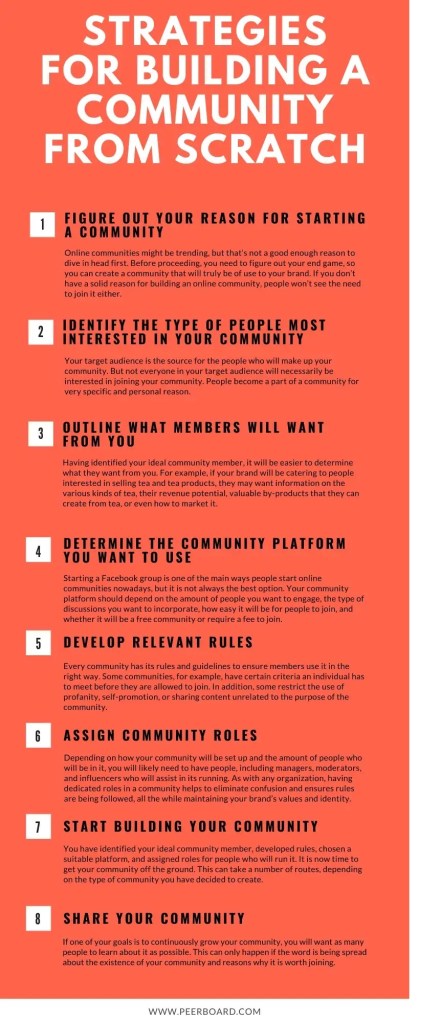
I’ve broken those steps down into a summary. These are the why, when, what, where, who—the five Ws that are intrinsic to many things. Including journalism.
Why do you want to build an online community? “Because they’re trending” isn’t good enough, think of a clearer goal or purpose. “To foster daily creative writing,” or “To share a love of Tom Hiddleston,” or “To provide tips and advice for a specific product or service.”
Who is your target audience? Figure out who would be interested in your community, and who, of those interested, might join. Also think of what roles your community might need—moderators, contributors, etc.
When: This one is a little harder, and not included in the graphic, but something important to consider is when your target audience wants to consume content. 9am? Only on weekdays? Different times on different days?
What content will you be producing? What will your members want from you? If your community is a group for people who love Percy Jackson, perhaps they want Percy Jackson memes, or updates on the upcoming TV show, but aren’t as interested in discussion about classic Greek mythology. It might be related, but not closely enough.
Where do your potential members hang out? Twitter? Facebook? Their emails? Consider these things when you choose the where of your community. What platform you want to build on. Also, consider what tools you will need. Newsletters, formatting, and engagement strategies.
Once you have all of that information gathered and decided on, then start building your community. And, once you have it built, share share share! Get the word out to that target audience. An unaware audience is an unengaged one.
Managing an online community
Online communities, just like any other community, require constant management and upkeep. Moderators to ensure everyone is following the community guidelines. A constant content stream to keep people engaged. Interaction to make members feel a sense of belonging that keeps them coming back.
“[A] flourishing community doesn’t just grow overnight.”
Explore different ways to drive engagement, like gamification, activation, and super-users. Make sure your community goal or purpose is stated clearly, and often. Maintain and enforce your rules and regulations. Check-in regularly with your members. Be mindful of the different categories your members might fall into. Explore your options for reaching future members, and expanding your accessibility.
Online Communities: should we, or should we not?
We should.
Not only do online communities serve the same unifying purpose as in-person communities, but they are also incredibly valuable to businesses and creators worldwide. It may seem underhanded to build a community for gaining revenue, but everyone has to eat somehow, so why not create something good while you’re at it?
I hope that Looking Glass will start to help support me, because if not I might have to put less into it, make it a sub-par space, just in order to put time into surviving. However, my goal for Looking Glass is to build a creative space free of bullying or gatekeeping. Too many times I hear the same story of people so bullied in workshops that they have given up on their writing. I gave up for a couple of years after one time too many of being told I had no place amongst those writing elites sitting at the same table as me, in the same workshop.
Collaboration and community are integral, amazing pieces of the writing process. Everyone deserves to have that opportunity. Constructively, not belittling.
 Nic Job
Leave a comment