

“Club Plum is a house party. We play all the good music. The DJ dances and laughs and knows that today is yesterday, and today is tomorrow, and pain is forever, so we’ve got to crack out the joy and ride the beat.”
Thea Swanson | founding editor of Club Plum
Club Plum is very near and dear to my heart, as it is the first non-student journal that my work was published in (“Santa Cruz”).
This tiny, just-for-the-joy-of-it journal is, truly, a house party. Club Plum is characterized by beautiful, eclectic art, and embedded songs from youtube on almost every page. Each piece ends with one such embed labeled after the author. For instance, after my author bio at the end of “Santa Cruz” is “A Song for Nic” (though I have not heard it before or since, I quite enjoyed it: Recovery by Ryan Lee West).
An Intimate Personal Project
Thea Swanson, the founding editor, created, launched, and now runs Club Plum completely on her own. This, I am sure, is part of the reason for the journal’s small size. One person can only do so much. Each issue only has about six to ten pieces of writing, and two to five pieces of art. The following is small as well, with only about 980 subscribers.
The intimate size of this journal, however, is a part of its charm. In an interview with Black Lawrence Press’ weekly newsletter Sapling, Swanson notes,
“I will not add on aspects to this journal that will overwhelm me such as creating a print version, giving or taking money, competing with other journals, turning this journal into a marketing venture, or expanding the masthead.”
She created Club Plum “purely for the enjoyment of making an ongoing piece of literary art.” This house party is the house party in her house on Plum street, where we few who know can experience the art gathered there.
“[Club Plum Literary Journal is] an ongoing conversation, a temporary but resonant entry into a beautiful or strange or dark or wondrous place.”
Thea Swanson | in an interview with Sapling
Limited Social Media Presence
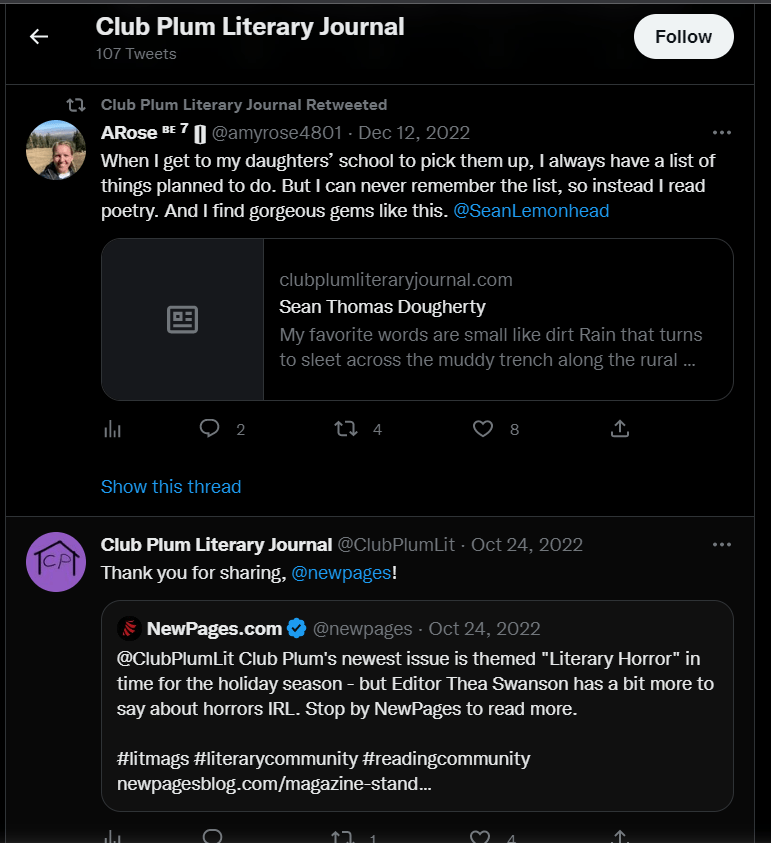
Club Plum does make use of some social media, with accounts on both Twitter and Facebook. Twitter seems to be a more popular social media in general for literary magazines, and proves true for Club Plum in that they have more than 700 followers on Twitter, as compared to barely 70 on Facebook.
These social media accounts are used to post about Club Plum news, such as Best of the Net nominations, and the blog-like posts Swanson writes for the homepage of the website between issue launches. Twitter sees more activity, with additional short posts recognizing Club Plum’s appearance on other sites (such as the interview with Black Lawrence Press), and reposting notes from contributors.
SEO, What SEO?
Beyond these few blog-type posts and minimal social media presence, it appears that Club Plum doesn’t actually spend much effort on an editorial strategy to increase traffic and readership. Some blog post titles follow common SEO and digital “rules,” such as “Best of the Net Nominations” and “The Police Station Had to Burn.” Most, however, follow the more literary trend of something “interesting” that hopes to “hook” a reader’s attention, but actually tells us very little about the content. Like “#Woman, Life, Freedom.”
It comes back to the house party. This is an intimate space, and the intention is that it will always be one. The simple web design, the lack of intentional SEO–Club Plum is what it is, and has a very strong little personality on its corner of the web.
Club Plum is sans subscriptions, sans ads, sans donations. It asks no reading fees, pays no contributors, and makes no money for the editor. It is “volumes of excellent words and compelling art made by writers and artists with [Swanson’s] help. This is enough.”
 Nic Job